
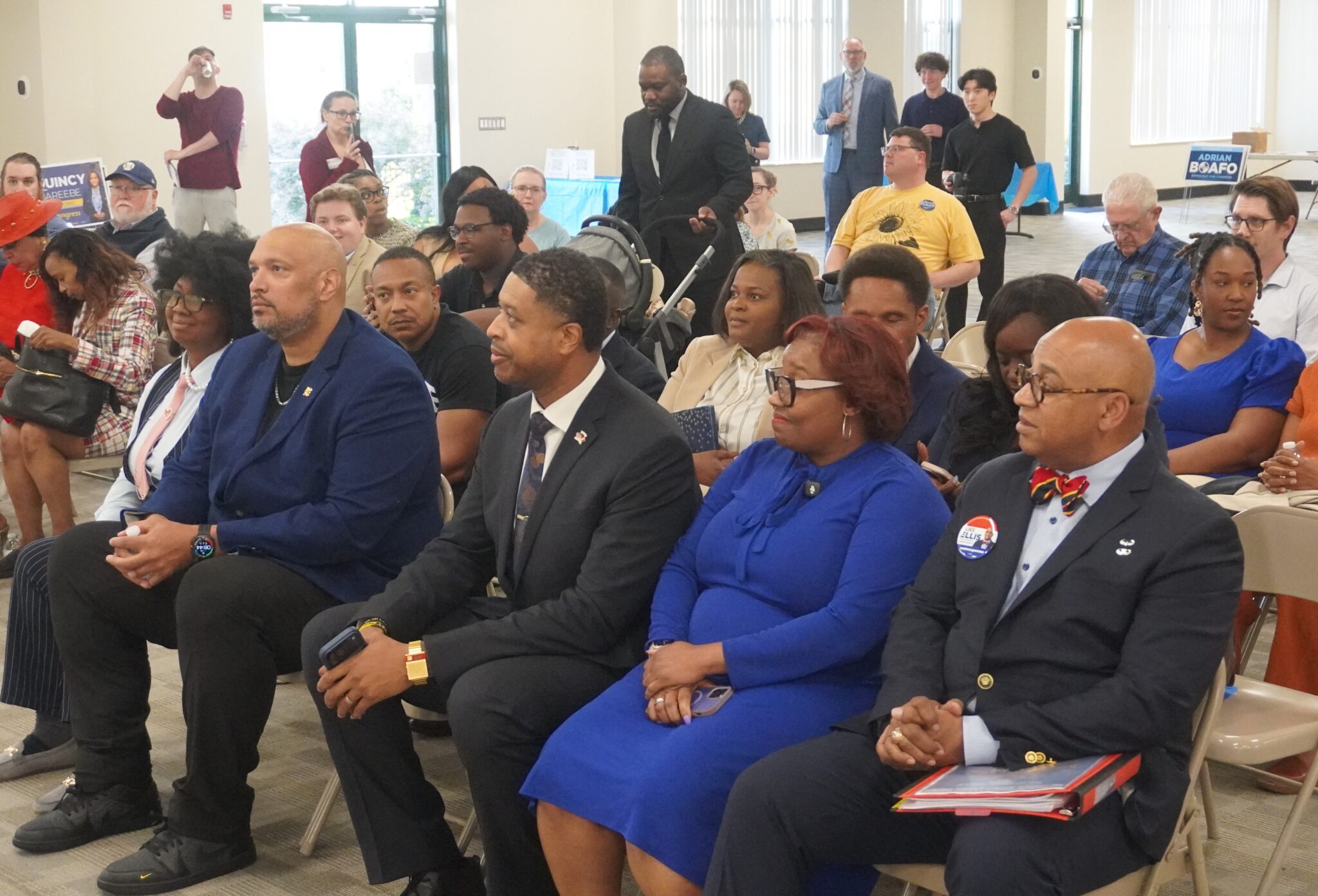
A number of vital primary elections are occurring in Maryland this year. What are the details?
by Boris Nusinzon
Since last year, anyone who follows the news to some extent will have heard the upcoming midterm elections mentioned in one manner or another. This November’s elections are pivotal in determining the balance of Congress and power for the remainder of Trump’s second term, as some of his legitimacy and power could be curbed through a “blue wave.” But in the immediate future, party primaries are taking place, and that’s occurring very soon in Maryland. The Primary Election Day is on June 23, with Early Voting taking place from June 11 to June 18. Residents can also vote by mail by June 23, with all the information for voting and voting registration available on the official Maryland Elections site.
The state’s primary elections—and more specifically, the elections for Calvert—are shaping up to be very interesting this year. The biggest race to watch is Maryland’s Fifth Congressional District (MD-05): Steny Hoyer held the House seat for Southern Maryland from 1981 until this year, or for a whopping 23 terms. Efforts to unseat the 86-year-old incumbent were repeatedly unsuccessful, and amid growing pressure for aged incumbents to resign (alongside Nancy Pelosi’s announcement that she would be resigning), Hoyer announced that he would not be running for reelection this year. This announcement was considered to have been made fairly late, though, as he made this announcement in early January with a candidate filing deadline on February 24, giving only around a month and a half for Democratic primary challengers to pile into the race.
And pile they did: By the filing deadline, a whopping twenty-four candidates had registered to run in the Democratic primary, and a mere three on the Republican side. This enormous Democratic primary has an eclectic field of candidates, ranging from members of the state Congress to veterans to commissioners to average people with no political experience. Some notable names are Adrian Boafo, a state delegate and Hoyer’s former campaign manager; Harry Dunn, a Capitol Police officer who defended it on January 6; Rushern Baker, former Prince George’s County executive; Arthur Ellis, state senator; and David Sundberg, former FBI assistant director, fired by Trump.
To point out one candidate as more important than another is a losing game in a race that has struggled with successful advertising and candidates standing out from each other. Adrian Boafo has been the most successful on this front, but truthfully, it is difficult to chalk his success up to anything but a mixture of PAC funds and having secured mass endorsements. The financial support secured from Hoyer’s AMERIPAC, as well as another cryptocurrency industry PAC, has allowed him to run ads en masse for his campaign.
Maryland Matters reported that “Hoyer endorsed his former aide early, calling Boafo ‘as strong as he is smart, as principled as he is pragmatic.’” He also “received consequential endorsements Friday from Gov. Wes Moore (D) and U.S. Sen. Angela Alsobrooks (D-Md.) – both of whom benefited from early Hoyer endorsements during their first statewide bids.” Furthermore, “In the first three months of the year, Boafo, who turned 32 on Mother’s Day, received direct campaign contributions totaling $14,000 from the 86-year-old former U.S. House majority leader and his leadership political action committee. Hoyer donors ponied up more than $140,000 – almost a third of Boafo’s campaign contributions during the first quarter of the year, according to campaign finance records… Some of Hoyer’s allies in the Washington, D.C., influence community and his network of national Democratic donors have contributed tens of thousands of dollars to Boafo… Most significantly, Hoyer’s leadership PAC, AMERIPAC, has so far spent half a million dollars on Boafo’s behalf.”

To say that Boafo is a favorite would be an understatement, especially as crypto and Israel-aligned PACs and donors have piled behind him in addition to elected officials. Other candidates, such as the aforementioned Harry Dunn, expressed distaste for this type of politics: “I’ve seen firsthand what happens when powerful interests think the rules don’t apply to them – and I’ve seen what it costs when they don’t.” With only one poll currently available for the race—a poll that is likely biased, having been sponsored by Rushern Baker’s campaign—it is difficult to know what voters’ preferences truly are.
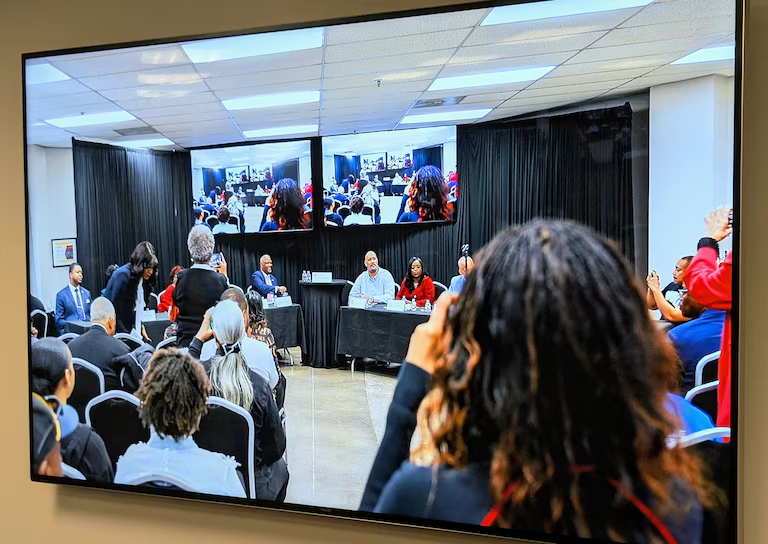
Candidates have tried their best to stand out from their fellow competitors in recent candidate forums in Prince George’s and Anne Arundel, but not every candidate was even at these forums. As The Banner put well: “Most of the candidates, of course, are kidding themselves… Winning a seat in Congress takes money, name recognition, a relentless schedule and a voter-turnout operation that can overcome an electorate diced among 23 candidates — or friends who can help achieve it. Baker has some of that, and Bareebe gave $3 million to her own campaign to buy it. Adrian Boafo hopes Hoyer and other supporters will give him the boost he needs to win it.” Complicating matters further is that mail-in ballots were sent in mid-May, yet the election field is still far from finalized: Delegate Nicole Williams dropped out of the primary after already being on those ballots, and more candidates could drop out before Election Day on June 23. The number of Democratic Party candidates is currently sitting at 23 as of May 18.
It is vital to understand that this House seat is more or less uncompetitive for Republicans, and even though there is a Republican primary, only three candidates are running in it. Due to a number of factors (including the fact that registered Democrats outnumber Republicans 2-to-1 in the district), the seat is rated as pretty solidly Democratic no matter what. This has made the primary even more competitive, as the winner is more or less guaranteed a seat in the 120th Congress.
The only other competitive Maryland primary in this election season is District 6, between April McClain Delaney and David Trone, the latter of which is looking to reclaim his House seat that he gave up for an unsuccessful Maryland Senate primary bid in 2024. An absurd amount of money has been raised for this race, one in which both candidates have been bitterly fighting for a position in the House./

On the state level, Calvert’s District 27B has a competitive Democratic primary between former Delegate Rachel Jones—who served in the Department of Agriculture for a few years after losing the primary to hold her seat—and the politician who beat her previously, Jeffrie Long Jr. Long has been somewhat ridden by scandal, between felony home invasion and assault charges that were repeatedly downgraded and dropped, and controversy around debt related to his church. In the State Senate District 27, meanwhile, incumbent Kevin Harris (recently nominated to replace Michael A. Jackson, tapped to be the Secretary of State Police) is being challenged by Jason Fowler, lawyer and Calvert County native, running on a policy of representing Calvert interests and opposing big business.


Finally, many local offices are up for grabs: There are County Commissioners, Central Committees, and Judges up for election. But more than that, two Calvert Board of Education seats are up for grabs, with the Republican-aligned incumbents being challenged by Dona Cox Ostenso and Anne Jones.
For those readers who are already 18 years of age or older, remember to register and vote in these elections coming up very soon. As mentioned at the beginning of the article, all information can be found on Maryland’s official elections site, including candidate information and polling locations.